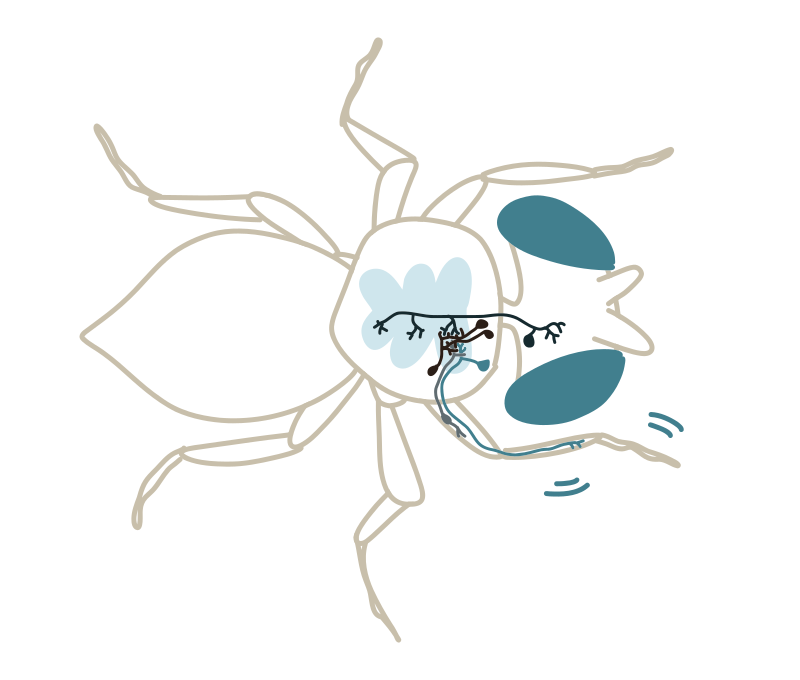
I am using computational approaches to study the structure and function of motor circuits in the fly ventral nerve cord (VNC, a spinal cord analog). Drosophila melanogaster is currently the most complex adult animal to have complete synapse-resolution neural wiring diagrams, called connectomes, of its brain and VNC. I use these connectome datasets as a basis for modeling neural activity in the VNC and identifying neurons for experimental recording and manipulation in real flies. I am especially interested in how premotor circuits transform coarse descending signals from the brain, like “walk forward” or “turn left,” into coordinated muscle movements. I am also interested in incorporating a biomechanical model to simulate the closed-loop modulation of these premotor networks by proprioceptive afferents. I hope that the connectome can provide big-picture insights into the neural control of limbed locomotion. I am co-advised by John Tuthill and Bing Brunton.
Past projects
Behavioral states and accumulation of sensory evidence in C. elegans
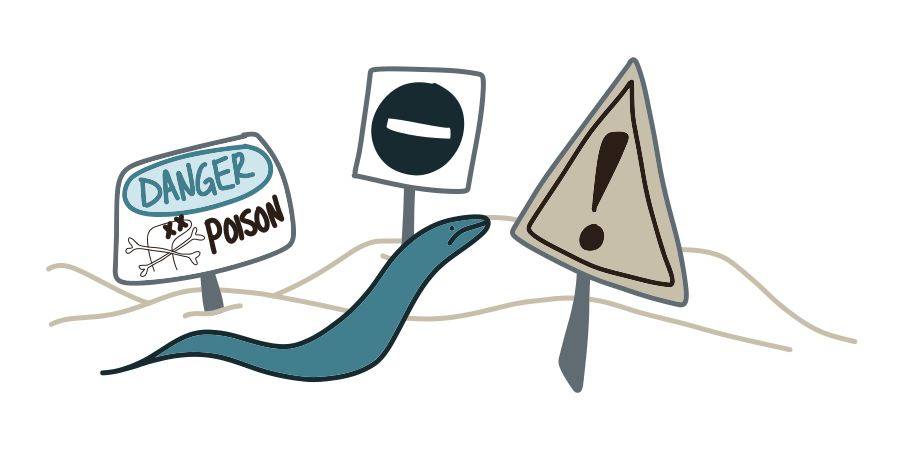
Before graduate school, I worked for 2 years as a research technician in the Flavell Lab at MIT. With postdoctoral researcher Dr. Saba Baskoylu, I studied the way that worms (C. elegans) change their behavior when they accumulate evidence that their environment is undesirable. The long-term goal of the project was to identify circuit mechanisms by which the nervous system produces an enduring change in mapping from sensory input to behavioral responses. To investigate this, I ran experiments where I optogenetically activated nociceptive sensory neurons and examined the animals’ behavioral responses, as well as companion assays using natural stimuli that the worms find aversive. I also assisted with several other projects in the lab to help quantify neuromodulatory effects on the worms’ locomotion and navigation.
Computational modeling of EEG/MEG currents in human neocortex
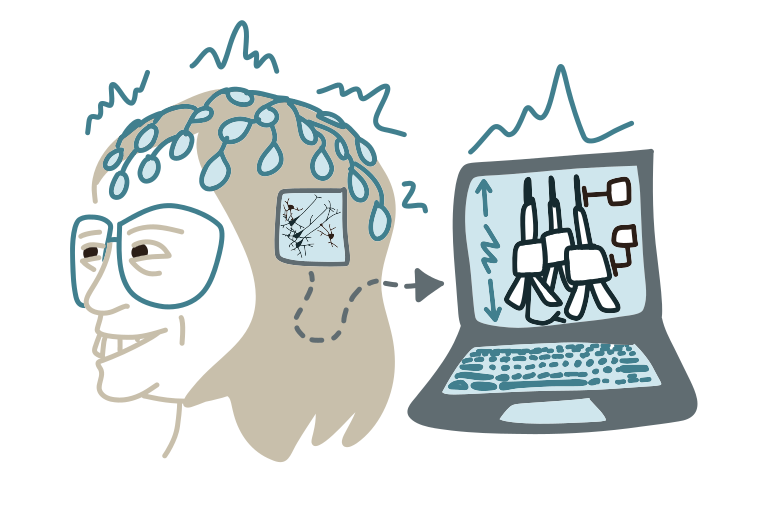
Electroencephalography (EEG) and magnetoencepholography (MEG) recordings are easy and non-invasive to obtain, and can provide useful biomarkers for clinicians, but it is difficult to understand how the underlying network activity in the brain generates the waveforms you can observe outside of the head. As an undergraduate in the Jones Lab at Brown University, I built upon the computational model the lab had developed to relate electrical currents from cortical pyramidal neurons to recorded EEG/MEG signals in order to simulate the contributions of dendritic calcium spikes to these waveforms. I updated the model layer 5 pyramidal neurons’ calcium channels to better fit electrophysiological recordings of these cells in other mammals, then examined the effects of calcium events on the simulated source-localized EEG signal. The improved model replicated findings in rats that dendritic calcium spikes have a distinct signature in surface recordings, and found that generally the sustained electrical activity in the distal dendrites during a dendritic calcium spike pushes a significant amount of current down the apical dendrite.